(This is the seven part of an essay from the book The Doctrine of Eternal Recurrence, presenting a previously unpublished genealogy of the thought of Eternal Recurrence in Nietzsche’s thinking. The first six parts of the essay can be read >> here.)
The “cosmological argument” by which Nietzsche sought to prove the certainty of Eternal Recurrence deserves to be quoted in full. And that is what we shall do, though piece by piece, since each part deserves a separate commentary of its own. Although contested and judged insufficient in its attempt to elevate the thought of Eternal Recurrence to the status of a scientific hypothesis, we shall show that it is not quite so harmless or innocuous to certain assumptions about the workings of the universe as a whole. This is how it begins:
The world of forces sustains no decrease: for otherwise it would have become weak and perished over infinite time. The world of forces sustains no standstill: for otherwise it would have been reached, and the clock of existence would stand still. (11[148])
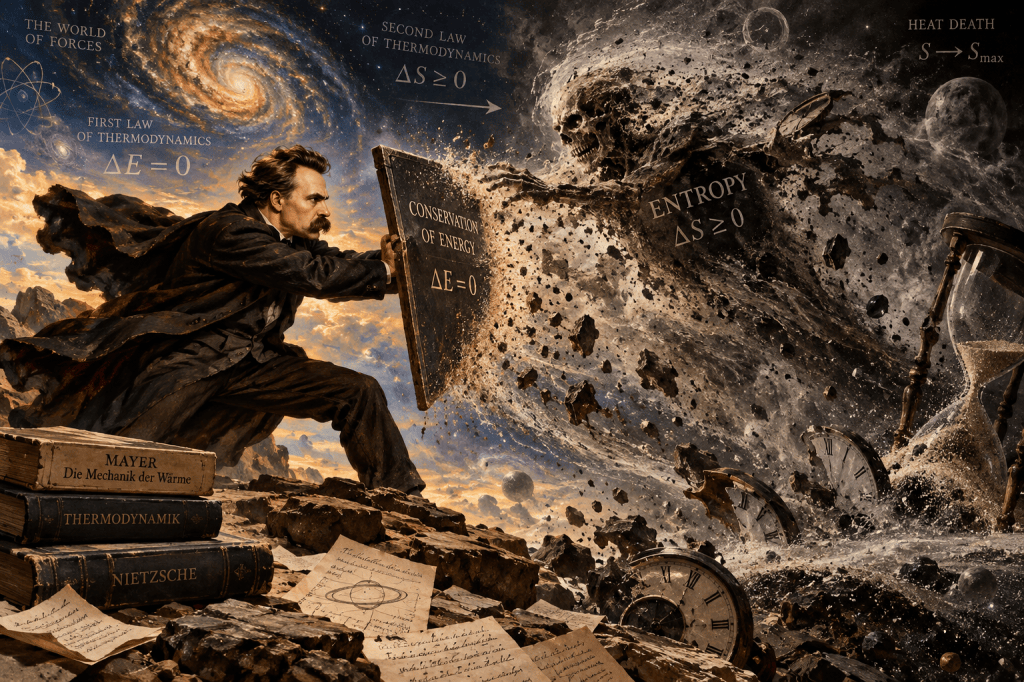
It is as though a third sentence were missing: the world of forces sustains no increase either: for if it did…? Well… what would happen “if it did”? Presumably, we would then be able to create a new quantity of force (energy) out of nothing, thereby opening up the possibility of a perpetuum mobile of the first kind. But that does not happen: what we witness is merely the transformation of energy from one form into another.
It should be stressed that by the middle of the nineteenth century, within thermodynamics, nearly all the fundamental principles concerning heat and energy had already taken shape, and Nietzsche must have been at least superficially familiar with them. From his letter to Köselitz (Peter Gast) of 16 April 1881, we know that he already had in his possession the physician Julius Robert Mayer’s Die Mechanik der Wärme in gesammelten Schriften, and that in the letter he singled out the essay Über Auslösung – in any case, several months before his illumination by the rock at Surlej. One serious study [Riedel, Manfred. Vorspiele zur ewigen Wiederkunft: Nietzsches Grundlehre, 2012, pp. 53–54] goes so far as to reconstruct Note 11[148] directly as an echo of Nietzsche’s reading of Mayer. It is nevertheless curious that, despite his familiarity with the thermodynamic laws of the time, Nietzsche frames his argument in the terminology of a “world of forces” rather than in terms of energy.
According to a later testimony by Lou Andreas-Salomé, Nietzsche would even come to entertain a plan to study the natural sciences, with the evident intention of supporting his “cosmological argument” with appropriate physical theories. This, as we know, never happened; but, as we shall see in Chapter Three, he would nevertheless begin to make regular use of the term Law of Conservation of Energy (for the First Law of Thermodynamics), as Mayer does in his book. We can only imagine the delight with which he regarded the fact that the Law of Conservation of Energy states, in dry scientific terms, what he employs in philosophical form to support the certainty of his own view of reality through the thought of Eternal Recurrence:
Therefore the world of forces never arrives at an equilibrium, it never has a moment of rest, its force and its motion are equally great at any time. (11[148])
Yet Nietzsche’s “cosmological argument” faces another, perhaps the greatest enemy of the “theory of Eternal Recurrence” – entropy. The Law of Conservation of Energy can no longer help him here: energy may be conserved while entropy nevertheless increases. The scenario of “heat death” therefore seems a particularly tough nut for Nietzsche’s “cosmological argument” to crack. Indeed, one gets the impression that Nietzsche rather casually “rules” that this scenario, too, must recur, and that the “world of forces” cannot remain forever even in a state of “heat death.” Although he does not explicitly mention “heat death,” such a conclusion can be read from the following sentence of the “cosmological argument”:
Whatever state this world can ever reach, it must have reached and not once, but countless times. (11[148])
After this “reckoning” – or perhaps merely “sweeping under the rug” whatever in the Second Law of Thermodynamics proves troublesome for the thought of Eternal Recurrence – we enter the realm of the hardest determinism, which suddenly clothes Nietzsche’s “cosmological argument”:
Likewise this moment: it was already here once and many times and it will likewise recur, all forces apportioned precisely as now: and likewise for the moment that bore this one and with the one that is the child of the current moment. (11[148])
No doubt, beautifully put; but the determinism that can be read from these undeniably harmonious and somewhat poetic words is not sufficiently explained. Why should this moment return precisely with “all forces apportioned precisely as now”? Because, Nietzsche answers, it is preceded by one precisely determined moment with its own distribution of forces. But why should one and the same distribution of forces necessarily always give rise to one and the same subsequent distribution of forces? Nietzsche unquestioningly binds the moments together so that one follows from another, but remains silent about the nature of their connection. A finite number of possible distributions of forces and infinite time might bring us to the “repetition” of some particular distribution – but not yet to the recurrence of an entire sequence of events identical down to the last detail. For that, one further assumption is required: that the same distribution of forces necessarily produces the same subsequent distribution of forces. Nietzsche, however, does not prove this here; he simply builds it tacitly into his argument. In this way, he hypostatises the most “hard-boiled” form of determinism – identical recurrence – precisely at the point where he ought first to have proved it. This is exactly why many regard his cosmological argument as insufficient.
The second part of the “cosmological argument” can hardly still be called cosmological, for it passes, we might say, into a poetic form in which it seems more intent on courting possible future disciples than convincing them by proof.
Human being! Your entire life is turned over again and again like an hourglass and will run out again and again with one prodigious minute of time in between, until all the conditions from which you have sprung, in the circuit of the world, come together again.
And then you rediscover every pain and every pleasure and every friend and enemy and every hope and every error and every blade of grass and every ray of sunshine, the entire coherence of all things.
This ring, in which you are a kernel, sparkles again and again. (11[148])
What are these inspired words seeking, if not disciples… disciples who, as we know, will in the end fail to appear… And then, to finish, the crescendo… The final paragraph of the “cosmological argument” is one of the most frequently quoted passages concerning the thought of Eternal Recurrence. Here the thought of Eternal Recurrence is put forward as a fateful moment for humanity, through which humanity reaches its noon, the zenith of its development.
And in every ring of human existence generally there (is) always one hour when the most powerful thought surfaces recurrence of all things first to one, then to many, then to all, the thought of the eternal each time for humankind it is the hour of noon.
We do not doubt it; but the road from the “most powerful thought” to a scientific hypothesis still lies ahead of us…..