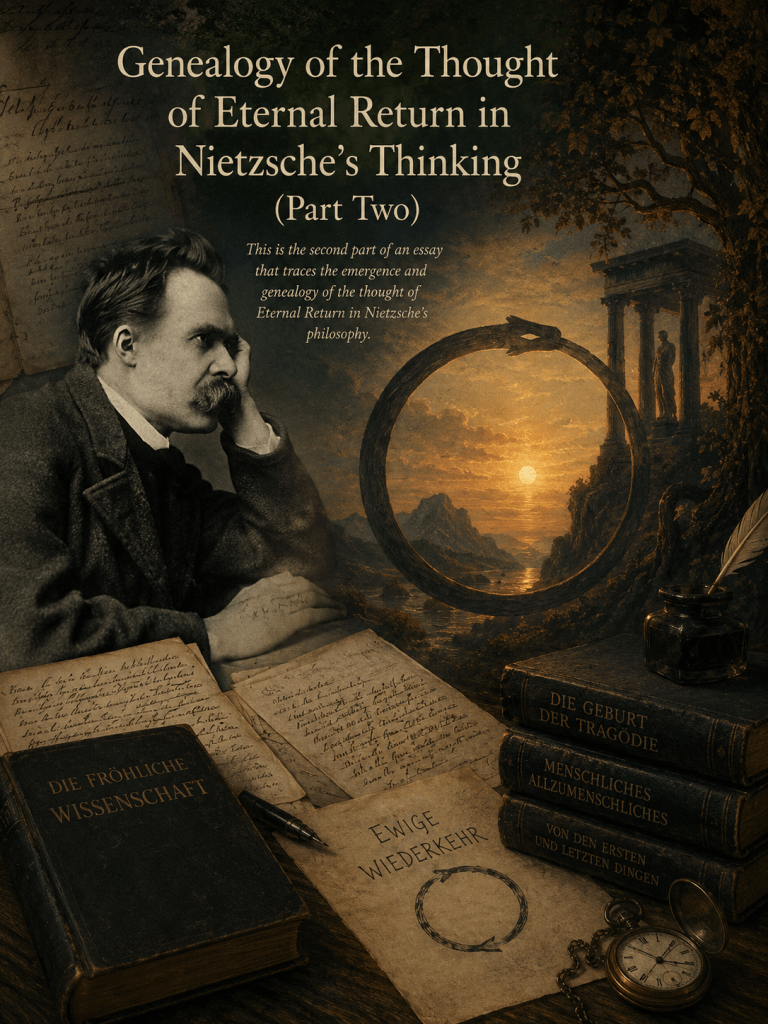
(This is the second part of an essay from the book The Doctrine of Eternal Return, presenting a previously unpublished genealogy of the thought of Eternal Return in Nietzsche’s philosophizing. You can read the first part of the essay >> here.)
It is significant that Martin Heidegger, after a meticulous study of Nietzsche’s literary remains — that precious “mine” of his entire philosophy — chose, at the beginning of the second volume of Nietzsche I, devoted entirely to the idea of Eternal Return, to mention an intriguing remark by the young nineteen-year-old Nietzsche as a possible first “nugget” of the thought of Eternal Return within Nietzsche’s “river of thought,” which was already, even at that time, swelling with unusual ideas. The passage in question comes from a youthful diary entry written in 1863 and discovered only in 1936:
“And thus the human being grows beyond everything that once surrounded him. He need not break his chains: unexpectedly, when God calls him, they fall away. And where is the ring that ultimately surrounds him? Is it the world? Is it God?” (Mein Leben. Autobiographische Skizze des jungen Nietzsche. Frankfurt am Main: Diesterweg, 1936.)
To be fair in our approach, Heidegger himself understood that the young Nietzsche was still merely searching for a final answer, a final truth about the world, and that the aforementioned “ring” was only a metaphor for that answer. Yet he advocated for Nietzsche’s archive to publish this “autobiographical sketch” in a special edition as an inspiration for young Germans.
Nietzsche himself could hardly have imagined that this metaphorical ring would one day return to him as an almost literal answer to his question — in the form of the thought of the “ring of Eternal Return.” It is therefore unsurprising that Nietzsche’s youthful path afterward no longer had much to do with that “idea.” Schopenhauer’s philosophy, Wagner’s music, and his professorship at the University of Basel came next; they led him toward other “rings of thought.” Still, in this context, we must not overlook his philological training and expertise in ancient Greek culture. Yet even when he writes about the Ancient Greeks, as in his youthful work The Birth of Tragedy, other motifs and archetypes dominate Nietzsche’s writing. They in no way suggest that Nietzsche was still searching for the “answer of all answers” — the “ring that ultimately surrounds man.”
Likewise, it should be noted that in this first phase of his thinking — during the period in which The Birth of Tragedy was written — Nietzsche was not particularly close to the later Greek philosophers – especially the Stoics, who are most often mentioned as the first inheritors of this “idea above all ideas.” Although some researchers into the genealogy of this thought, such as Lawrence Hatab, believe that it originates from the pre-Socratics Nietzsche admired far more — specifically Empedocles or even Pythagoras — Nietzsche himself never explicitly connected it with them.
And if we are to be fair in our approach, in that period Nietzsche was closest to the thinking of perhaps the boldest of all the pre-Socratics — Heraclitus of Ephesus. In the next book he wrote — though one he would never publish during his lifetime — Philosophy in the Tragic Age of the Greeks, Nietzsche praises and elevates Heraclitus above all others, not only in relation to the post-Socratics and Socrates himself, but even in relation to the other pre-Socratics. And one gains the impression that he does so above all in opposition to Parmenides.
Unlike this Eleatic, who regarded the world as motionless and unchanging, with always the same “old sun,” the Ephesian maintained that the world is driven by the eternally new flame of an ancient fire. Thus, the river into which a man steps twice is never the same river, but always another one, just as the sun that rises each morning upon the horizon is never the same sun, but another, or a new one. And what could be further removed from belief in Eternal Return than the assertion that the river into which one steps is eternally new, and that the sun which illuminates him every morning is likewise ever-new?
We should note, however, that there are interpretations which do not regard Heraclitus’ teaching as diametrically opposed to that of Parmenides, considering such an opposition overly simplified. Heraclitus’ statement “everything flows” (panta rhei) is not one of his literally preserved sayings, but rather a later summarizing formulation of his teaching. As such, it merely points to the fact that the world becomes, that it constitutes an ongoing happening or event. On the other hand, Parmenides’ statement that “Being is” (esti gar einai) may likewise be interpreted in terms of the world’s becoming — or, in Parmenides’ case, the becoming (or coming-to-presence) of Being itself.
But let us return to Nietzsche. Only after his break with Wagner and Schopenhauer, and after that depressive winter in Sorrento (1876–77), spent with Malwida von Meysenbug, during which he began work on Human, All Too Human — and in which, for the first time, an eschatological chapter appears, On First and Last Things, placed at the very beginning of the work — can we say that Nietzsche became seized by a mood that would ultimately lead him toward thoughts resembling those he had recorded in his youthful years. In a certain sense, we might say that he once again began the search for the ancient “ring that ultimately surrounds man…”
Deeply disappointed in humanity, Nietzsche began to look differently upon nature and the world around him. He reflected more and more upon his health and upon the almost miraculous effect of changing climates in accordance with the seasons, something he increasingly practiced in order to regenerate himself. At the same time, his entire thinking seemed to undergo a regeneration as well…..
(To be continued…)