(This is the fourth part of an essay from the book The Doctrine of Eternal Recurrence, presenting a previously unpublished genealogy of the thought of Eternal Recurrence in Nietzsche’s philosophizing. The first three parts of the essay can be read >> here.)
At last, something strange began to happen in Nietzsche’s life in August 1881. That year, he stayed for the first time in Sils-Maria, an enchanting village in the Swiss Alps near the Italian border—and he was captivated by it. The transformation of his soul was already complete. The dawn glow of his new thoughts, expressed in the book of the same name, had spilled over into his own life and taken possession of his personal horizon.
In a letter to Peter Gast dated August 14, 1881, Nietzsche wrote excitedly:
“Now, my dear and good friend! The August sun shines over our heads, the year is fugitive, it grows quieter and more peaceful on the mountains and in the woods. Thoughts have been looming on my horizon the like of which I have never seen — I don’t want to say a word about them, I want to preserve an unruffled calm in myself. It seems I shall have to live several years longer. (Letter to Heinrich Köselitz [Peter Gast], August 14, 1881)
Could it be that during those very August days the most powerful thought ever to enter Nietzsche’s mind—the thought of Eternal Recurrence—first occurred to him?
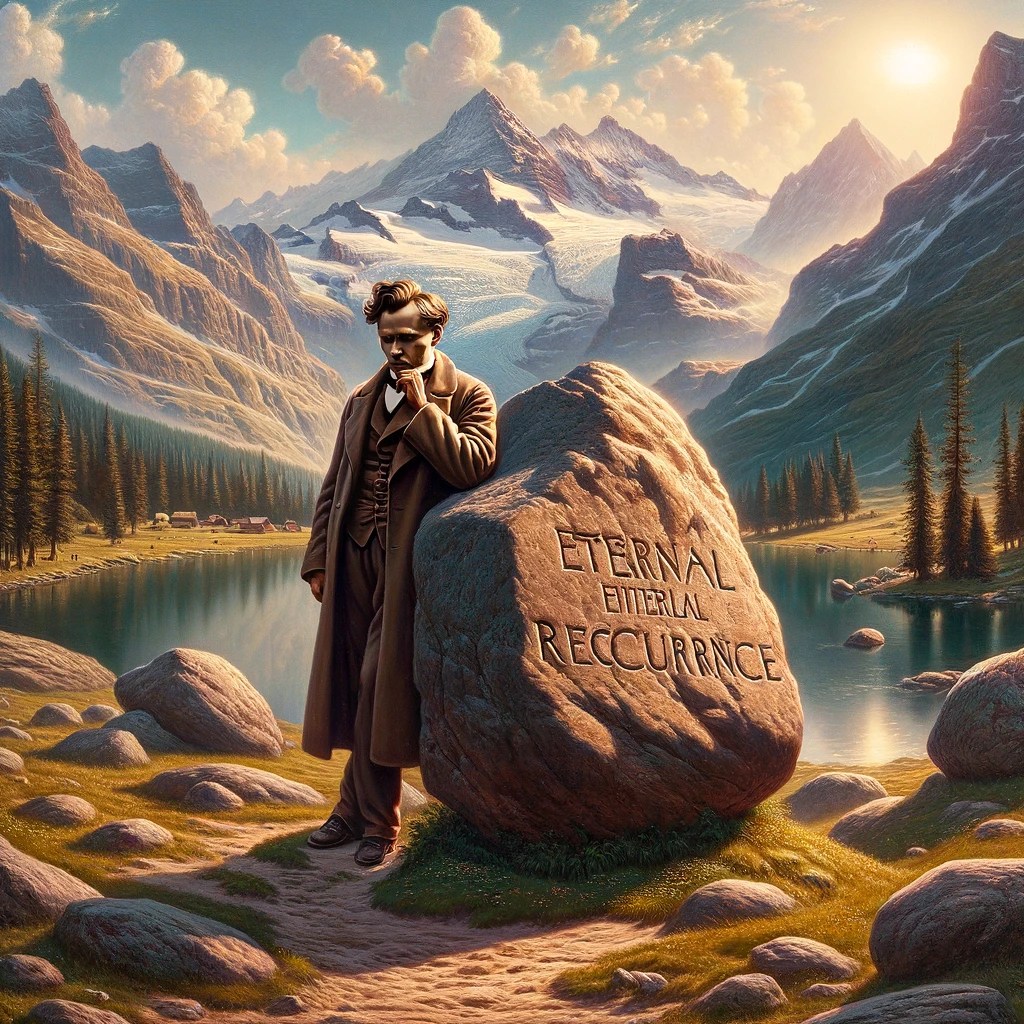
We have little doubt that it happened during one of his walks around the enchanting Lake Silvaplana, surrounded by equally enchanting mountain peaks. Nietzsche’s biographers generally agree that this is indeed what happened, and they even identify the precise location: a particular rock near Surlej on the shore of the lake. Such an almost fairy-tale scenario is suggested by Nietzsche himself in his somewhat self-aggrandizing autobiographical work Ecce Homo, written during the last year of his conscious life (1888).
At the beginning of the chapter devoted to the genesis of Thus Spoke Zarathustra—that “book for all and none”—he writes:
“I now wish to relate the history of Zarathustra. The fundamental idea of the work, the Eternal Recurrence, the highest formula of a Yea-saying to life that can ever be attained, was first conceived in the month of August 1881. I made a note of the idea on a sheet of paper, with the postscript: “Six thousand feet beyond man and time.” That day I happened to be wandering through the woods alongside of the Lake of Silvaplana, and I halted not far from Surlei, beside a huge rock that towered aloft like a pyramid. It was then that the thought struck me.” (Ecce Homo, “Thus Spoke Zarathustra,” §1, 1911. Available at: https://www.gutenberg.org/files/52190/52190-h/52190-h.htm)
The page in question is dated August 6, 1881—only eight days before the letter itself. [1] Rüdiger Safranski, perhaps Nietzsche’s most distinguished biographer, writes that until that day in August 1881 Nietzsche had only vaguely sensed what his task was, whereas now he had finally found it. In the same letter Nietzsche continues:
“Oh, my friend sometimes the realization runs through my head that I am actually living a supremely dangerous life: for I belong among those machines that can explode! The intensities of my feeling make me shudder and laugh aloud — already on several occasions I was unable to leave my room for the ridiculous reason that my eyes were inflamed — from what? On each occasion I had been weeping excessively during my hikes the day before; no, not sentimental tears, but tears of exultation; during which I sang and muttered nonsense, filled to the brim with my new vision, which I am the first of all human beings to have.” (Letter to Heinrich Köselitz [Peter Gast], August 14, 1881., Available at: https://press.uchicago.edu/Misc/Chicago/452786.html)
Regardless of whether Nietzsche’s “highest thought” first occurred to him beside a mighty rock under such sublime circumstances, we wish to emphasize the following: the thought of Eternal Recurrence does not choose the circumstances under which it enters a person’s mind and, in the very same instant, takes possession of his entire being. It is equally important to recognize that this unnecessary mythologization of Eternal Recurrence does no harm to the teaching itself. It remains untouched by what Nietzsche called the “human, all too human,” just as it remains unaffected by the more prosaic circumstances of its appearance, for example, in the life of the author of these lines. [2]
Herein lies the greatest strength of Eternal Recurrence: one may experience it at any moment of one’s life, regardless of circumstance. Nothing is too insignificant for Eternal Recurrence. Even the most banal thought and the most trivial situation are subject to the same primordial eternal law and thereby become sublime and primordial in their own right. In touching the ring of Eternal Recurrence, we ourselves become like it—pale, glittering, mute, tremendous… as Nietzsche himself suggests in that evocative aphorism from Daybreak that we mentioned earlier.
[1] For the postmodern reader, it is difficult to dispel entirely the suspicion that Nietzsche subsequently mythologized the circumstances under which the thought of Eternal Recurrence first came to him. Yet we possess no evidence whatsoever for such a supposition.
[2] More specifically, in my own case, my own awakening to this thought occurred in the bathroom of my apartment. It happened in the evening, after a shower, while I was drying myself with a towel after stepping out of the bathtub. Before me there was no “mighty pyramidal rock,” but rather a cabinet filled with ordinary toiletries, greenish bathroom tiles, and two towels hanging on the wall. Yet I remember distinctly that my gaze was fixed upon two brown central-heating pipes when I experienced that peculiar expansion of the mind, prompted by the question: “And what after that?” During those days I often found myself asking this question, following in thought the chain of cosmic events all the way to its ultimate limit. If all possibilities must eventually be exhausted, I thought, then endless novelty cannot endure forever. Following this logic of ultimate consequences, I arrived at the conclusion that everything in this world must return, that nothing can remain eternally new. The only difference between my own insight and Nietzsche’s was that, for us in the twenty-first century, mythological embellishments are no longer required to lend greater persuasiveness or sublimity to the fundamental insights we attain about the world and about life.