(This is the sixth part of an essay from the book The Doctrine of Eternal Recurrence, presenting a previously unpublished genealogy of the thought of Eternal Recurrence in Nietzsche’s thinking. The first five parts of the essay can be read >> here.)
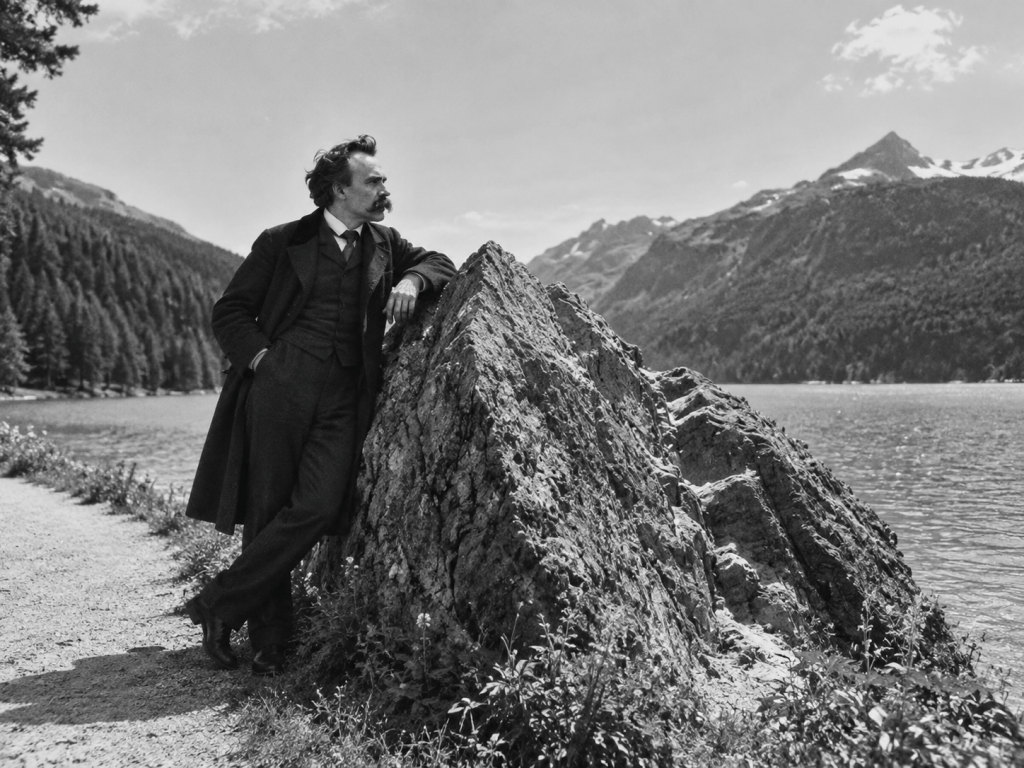
During that fateful August of “war” – for the thinker as much as for the thought of Eternal Recurrence itself – Nietzsche wrote dozens of notes on the thought that had seized him by the rock near Surlej. From note 141 all the way to note 167, his writings are dominated by this thought and by what follows directly from it. We should not lose sight of the fact that this is the earliest view of the newly born thought of Eternal Recurrence. From note 168 onward, Nietzsche gradually returns to his usual themes, but they now seem as though coated with the patina of the “thought of thoughts.” It occasionally emerges in them, only to disappear again, as though it were a kind of mirage of the thinker’s mind.
But let us proceed in order. In the very next note (142), Nietzsche tries to “bring the ball back down to earth,” to temper his initial exhilaration over the “most powerful insight,” and to dispel from the outset any thought that what has occurred is the birth of a new religion:
Do I speak like someone who has had a revelation? Then despise me and do not listen to me. (11[142])
And then, in the following note (143), we come perhaps to the hardest aspect of this thought to accept if it is to become embodied in a human being. Nietzsche begins his reflection with the sentence:
“But if everything is necessary, what control do I have over my actions?” This thought and belief is a weight that presses on you along with all other weights, and more than them.” (11[143])
Indeed, if everything has already “happened once” and will continue to happen with the same necessity – “what control do I have over my actions?” The answer the thought itself gives him is terrifying: none. Why, then, make any effort at all if everything has already been determined in advance? Anyone who has become conscious of this dreadful aspect of the thought of Eternal Recurrence would rather flee from it. And that is precisely what people do – they flee headlong from the thought of Eternal Recurrence! Nietzsche, however, does not. Although he had already seen what a burden his thought had placed upon the human being, in the notes that follow he seems to try to recoil from the experience of bearing it. He continued to wrestle with the thought, attempting somehow, almost miraculously, to tame it. In note 143, we find him taking another direction:
You say nourishment location air society transform and condition you? Well, your opinions do it even more, for they condition you to this nourishment location air society. If you incorporate the thought of thoughts, then it will transform you. (11[143])
The final sentence unmistakably reveals Nietzsche’s main intention and the “war tactic” by which he sought to win this ectoplasmic battle. Yet we must be very careful with this sentence. “If you incorporate the thought of thoughts, then it will transform you” – what did Nietzsche mean when he wrote this? How can the thought of Eternal Recurrence transform us if everything has already been determined in advance?
…..in sum wait to see how extensively knowing and truth can be incorporated- and to what extent a transformation of the human being ensues, once he finally lives only for the sake of knowing. (11[141])
Nietzsche had already written this in the first note. The German einverleiben, rendered here as “incorporate,” carries the stronger sense of embodying or making something part of oneself. If we now think the thought of Eternal Recurrence through to its ultimate consequences, it may or may not become embodied in us – but what matters is to recognise that we are not the ones who decide this. It is as though the thought itself chooses in whom it will become embodied and in whom it will not. Perhaps, then, the only thing we can do is learn to accept it? Not even that – the thought itself tells us, once we think it through to its ultimate depth. For even our acceptance or rejection of it is already “built into” us – and that, too, is part of its embodiment. At the very moment when we think we are deciding whether to accept the thought or flee from it, we are in fact merely reading the already written text of our own life.
This means only that the thought of Eternal Recurrence compels us, in a terrifying way, to relinquish the illusion of control and simply observe our life, which is as it is because it could not have been otherwise. Our consciousness of this is nothing but an organon of knowledge, and it now becomes clearer why, in the preceding note, Nietzsche connected transformation through this thought with living “only for the sake of knowing.” If nothing else, we no longer need to torment ourselves over the bad decisions we have made in life, nor take pride in the good ones; if nothing else, we can enjoy the “image of our own ideal” created by the “exalted states we have experienced” – and nothing more.
Yet this note of Nietzsche’s reveals something else as well—the necessary dependence of the moments from which the Ring of Eternal Recurrence is woven upon one another. This dependence allows us to understand not only why we are what we are, but perhaps also how recurrence itself is possible in the first place. If “nourishment, location, air, and society transform and condition you,” then the thought of Eternal Recurrence that occurred to you at a particular moment changes and shapes you as well. And since the Ring of Recurrence is one, each of its moments is conditioned by the moments that preceded it, just as it in turn conditions the emergence of the moment that follows. Somewhere, in the end, this unbroken chain of moments joins itself and closes the Ring. The impression arises that everything happens only once—as, from the perspective of our consciousness, it indeed does—because we can never become aware of recurrence itself. The impression of free will that we have may be nothing other than our awareness that the present moment shapes the next. More will be said about this aspect of the thought of Eternal Recurrence in the third chapter.
In the concluding part of the same note, carried away by the idea of the transformation a thought can bring about in an individual, Nietzsche asks: “is it such that I want to do it countless times?” If this is a kind of test of whether the thought of Eternal Recurrence can become embodied in us, the question makes sense. But if it means that from now on we should conduct our lives in such a way that we consciously do only what we would wish to do “countless times,” then this moral imperative, as we shall show later, makes little sense. Nevertheless, the ethical interpretation of Eternal Recurrence as a kind of moral imperative remains one of its most influential contemporary interpretations, and in various forms it can be found in Walter Kaufmann, Alexander Nehamas, Maudemarie Clark, Bernard Reginster, and others.
An echo of this sentence can be found two years later in Zarathustra, where Nietzsche makes an almost impossible demand of his own will: that, through gritted teeth, it should gloriously proclaim of everything that has happened: “But thus I willed it, thus shall I will it!” This imperative was meant to become the wedding ring uniting two of the most fiercely opposed thoughts in Nietzsche’s thinking—the Will to Power and Eternal Recurrence. Yet here a problem arises, one already identified by Karl Löwith when he showed that one cannot will what has already happened (Löwith, 1935). To that extent, the call to embody the thought of Eternal Recurrence so that it might transform us becomes deeply problematic. With all due respect to Nietzsche’s intentions, on this point we must concede that this thinker, who was hardly sympathetic to Nietzsche, was right. This possible interpretation will be discussed further in the third chapter of the book.
For now, let us repeat only this: if Eternal Recurrence were the truth of this world, we could not will what has already happened, nor could we now freely determine how our life is to unfold, as some of these interpretations suggest. We can only live out our life and gradually discover why we are what we are. The aforementioned moral imperative – “act in such a way that you would wish to act eternally” – would make literal sense only if we were living this life for the first time and only afterward began to live through its infinite recurrences. But then we would no longer be speaking of Eternal Recurrence in its strict sense. Accordingly, we can only imitate that desire, that imperative.
As though momentarily sobered from these groundless hopes, in the next note, 144, Nietzsche writes a thought that points in precisely this direction:
“If the thought of the eternal recurrence of all things does not overwhelm you, then it is not a fault: and it is no merit if it does.” (11[144])
In the notes that follow, it is as though he once again climbs onto a rock from which the thought of Eternal Recurrence offers a more optimistic vista: he speaks of a new education (11[145]), an inclination towards the new (11[146]), and of the first followers of the teaching, whom he sees as “weaker emptier sicklier needier”, believing that the new teaching will find its finest representatives only at the end (11[147]).
Nietzsche presents his famous “cosmological argument,” well known from discussions of Eternal Recurrence, in the following fragment (11[148])—and with it we shall begin the next post…