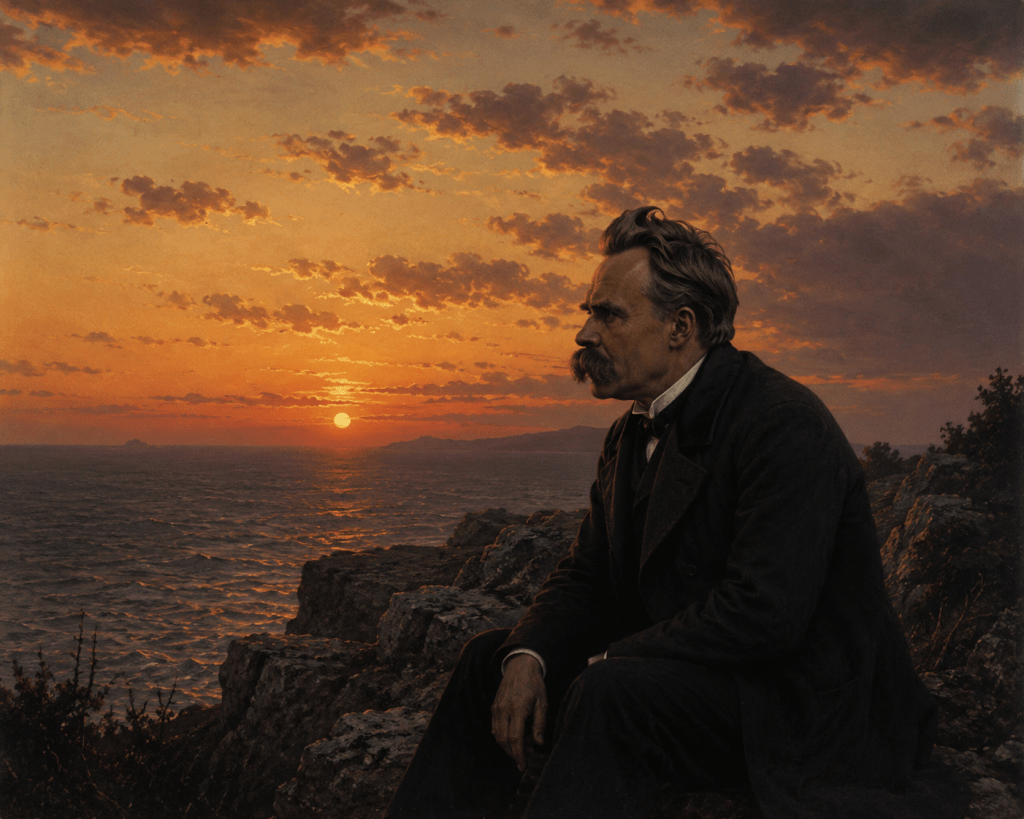
(This is the third part of an essay from the book The Doctrine of Eternal Recurrence, presenting a previously unpublished genealogy of the thought of Eternal Recurrence in Nietzsche’s philosophizing. The first and second parts of the essay can be read >> here.)
At last, in 1880, Nietzsche writes a work that is, in many respects, a turning point—a book that reflects his new state of mind. The title Morgenröte (Dawn or Daybreak) was not chosen by accident. Nietzsche awakens into a new morning after a long sleep; he emerges to the surface after having spent a long time underground (like a mole digging tunnels, as he himself wrote in the opening aphorism). He stands at the dawn of a new life, and within his mind entirely new thoughts are quite literally beginning to break.
Approximately a year before the thought of Eternal Recurrence occurred to him, while writing Morgenröte, Nietzsche was seized by a strange and universal feeling of primordial solitude. He did not associate it with himself as an individual, but with nature as a whole, with the primordial solitude of everything that is. A testimony to this feeling—which we regard as yet another precursor to the thought of Eternal Recurrence—can be found in an aphorism at the beginning of the fifth and final part of the book. It contains one of the most beautiful poetic images in prose that the philosopher ever wrote, dedicating it to nature, the sea, and the evening twilight, while only dimly sensing the secret they conceal:
In the great silence. — Here is the sea, here we can forget the city. The bells are noisily ringing the angelus it is the time for that sad and foolish yet sweet noise, sounded at the crossroads of day and night but it will last only for a minute! Now all is still! The sea lies there pale and glittering, it cannot speak. The sky plays its everlasting silent evening game with red and yellow and green, it cannot speak. The little cliffs and ribbons of rock that run down into the sea as if to find the place where it is most solitary, none of them can speak. This tremendous muteness which suddenly overcomes us is lovely and dreadful, the heart swells at it. Oh the hypocrisy of this silent beauty! How well it could speak, and how evilly too, if it wished! Its tied tongue and its expression of sorrowing happiness is a deception: it wants to mock at your sympathy! So be it! I am not ashamed of being mocked by such powers. But I pity you, nature, that you have to be silent, even though it is only your malice which ties your tongue; yes, I pity you on account of your malice! Ah, it is growing yet more still, my heart swells again: it is startled by a new truth, it too cannot speak, it too mocks when the mouth calls something into this beauty, it too enjoys its sweet silent malice. I begin to hate speech, to hate even thinking; for do I not hear behind every word the laughter of error, of imagination, of the spirit of delusion? Must I not mock at my pity? Mock at my mockery? O sea, O evening! You are evil instructors! You teach man to cease to be man! Shall he surrender to you? Shall he become as you now are, pale, glittering, mute, tremendous, reposing above himself? Exalted above himself? (Nietzsche, Friedrich. Daybreak: Thoughts on the Prejudices of Morality, Aphorism 423, trans. J. M. Kennedy. New York: The Macmillan Company, 1911. Reproduced at: http://nietzsche.holtof.com/reader/friedrich-nietzsche/daybreak/aphorism-423-quote_f8b93657d.html)
Reflecting upon this image, it should become clearer why we believe that new thoughts do not simply emerge out of nowhere. They truly have a history of their own. The thought of Eternal Recurrence must already have been circling through Nietzsche’s mind, if only in the form of a vague premonition or the faintest of intimations, not only during the writing of Morgenröte, but even earlier, during the period of the youthful diary mentioned by Heidegger. Yet in the case of this aphorism, the feeling, the premonition—or perhaps both together—are stronger than ever before…
(To be continued..…)