On this blog, a book is being written… Its title is The Doctrine of Eternal Recurrence… It consists of eight chapters and is composed — in the old Nietzschean tradition — of aphorisms… The aphorisms are published in the form of posts…
You can access the contents of the book in progress through a dedicated Admonition page >>> THE DOCTRINE OF ETERNAL RECURRENCE (Book).
It is intended primarily for those individuals who, in their own way, feel called to faith in Eternal Return, just as the author of this blog once did. These are individuals who, even if they wished to, can no longer believe in religious stories of an afterlife, of immortal existence beyond death, yet who are, on the other hand, troubled — even horrified — by the prospect of their own finitude: that once they die, they die forever, as contemporary science would have it. Only such individuals may (though need not) feel the call to faith in a “third way” — the way of Eternal Return of the Same.
On the >>> MISSION STATEMENT page, you can gain insight into the full purpose (mission) behind the launch of this blog.
Why can the pages of the Book be accessed only through the Admonition page? The only question that arose in the author regarding the justification for launching this blog was this: can at least one human being on this planet endure Eternal Return? Since the author himself is the best proof that this is possible, there remains the possibility (however small at present) that, for others as well, this Doctrine may one day become not only bearable but necessary in order to endure existence at all (an existence in which no other meaning is contained except return). The Admonition is not intended for them. However, since this blog will also be approached — more out of curiosity than genuine need — by those who are probably not yet prepared for the possibility that this one and the same life, such as it is, might repeat itself (for although they love themselves, they do not love their own life), such readers are advised to read the full text of the Admonition first, on the page >>> ADMONITION!
This blog does not seek to persuade anyone to believe in Eternal Return! But nevertheless! The second, more general purpose of the blog and of the book The Doctrine of Eternal Return is to indicate a path (which, at this moment, appears unlikely) that humanity, to a greater or lesser extent, might one day follow… and to affirm that this path is a human one — which also means to set out clear guidance on how Eternal Return — should it prove to be “the case” — may be endured. In that sense, the book is a kind of revelation, but also a preparation for faith in Eternal Return, through which humanity might enter a new epoch in order to avoid the danger of nihilism that seriously threatens our time — a danger that threatens not only the collapse of society as a whole, but the very survival of our species.
The anonymity of the author of the blog and the book is justified by the desire to bring the proclamation of the Doctrine to the forefront — and not anything else. He seeks nothing for himself from that proclamation. Although he presents himself as a Teacher of Eternal Return, he is not even certain that he is a good Teacher… There are days when the pages of the blog record not a single visit (should that change — it will be noted here)… But nevertheless, this is entirely understandable, for the thought of Eternal Return — we may freely say so — is perhaps one of the most demanding thoughts ever conceived about how things truly stand in this world. It repels from the very outset, for it appears impossible. Be that as it may, and regardless of whether this Teacher of Eternal Return will succeed in his task of transmitting the Doctrine or not, only one thing matters: the proclamation of the Doctrine of Eternal Return — and that it reach those to whom it is truly necessary.
The author seeks to substantiate his competence to write such a book by pointing to evidence of his extensive engagement with Nietzsche’s thought of the Eternal Recurrence of the Same, which has led to the creation of the page >>> NIETZSCHE ON ETERNAL RECURRENCE, where all of Nietzsche’s recorded reflections on Eternal Return will be gathered, as well as the page >>> BIBLIOGRAPHY, which lists the extensive literature on Eternal Return — including books, chapters, scholarly articles, and other contributions by other authors devoted to this ‘thought above thoughts’ of our Teacher — and which will likewise be expanded over time.
Your — publicly visible — comments may be left only on the dedicated page >>> WHY I (DO NOT) BELIEVE IN ETERNAL RECURRENCE. As the very title of the page suggests, there you may write why you believe or do not believe in Eternal Return and participate in a short poll in order to assist in the writing of this book. The possibility of sharing the book’s content on other platforms has been retained, but the options for public liking and commenting on each page and every post have been removed — for the same reasons that led the author to choose anonymity: so that the reader may be directed toward the content of the Doctrine, rather than toward information about the individuals who read it… In time, space may be opened within the blog for a forum discussion of the book’s content; whether such a space will ever be needed, time will tell…
That the Doctrine, according to our taste, has its own music as well can be discovered on the page >>> Music of Eternal Recurrence.
For the time being, suggestions for improving the book, advice, wishes for discussion, and the like may be submitted in written form and sent to teacherofeternalreturn@gmail.com. The author will gladly respond to them — and in a somewhat more informal tone…
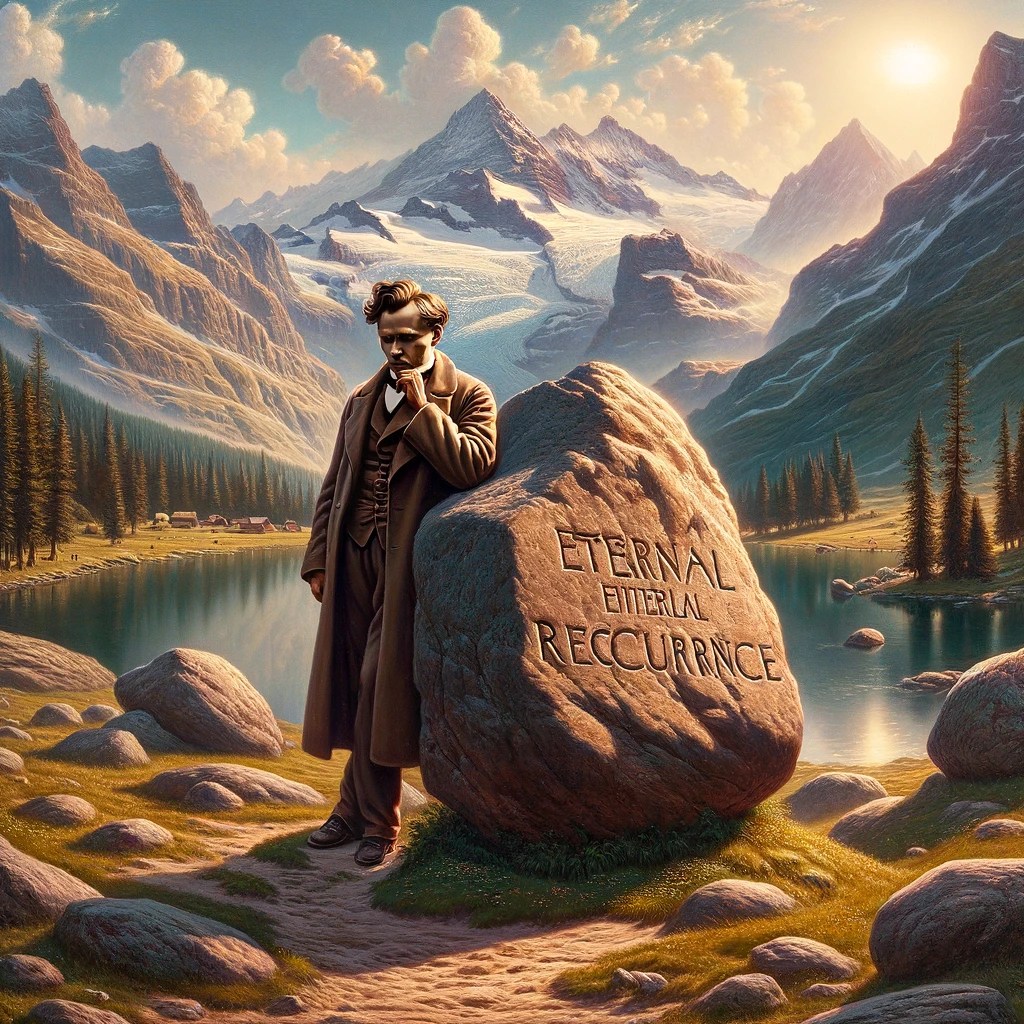
 The Doctrine of Eternal Recurrence