(Doctrine of Eternal Recurrence — INTRODUCTION, aph. 11, final)
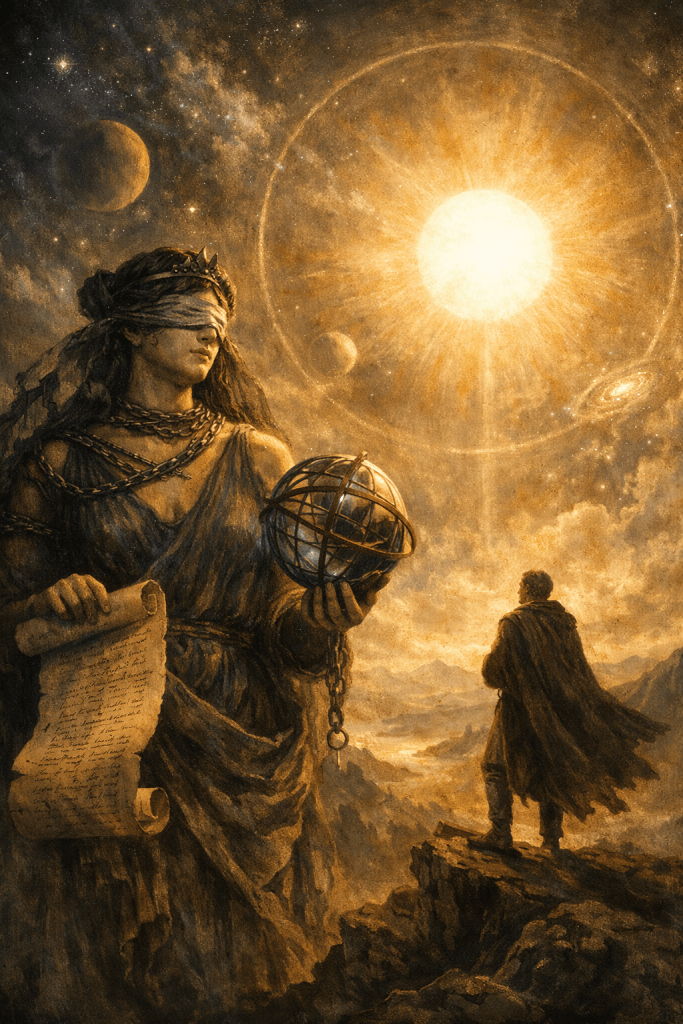
Finally, and at the close of this Introduction, we may speculate that Eternal Recurrence resembles Ananke (Ἀνάγκη), the Greek principle of necessity that compels the world to return — by necessity, and not merely as one possibility among many. This insight comes closest to our insight-feeling of Eternal Recurrence mentioned in the Preface. Everything that exists — matter and time, space and gods, human beings and all other living creatures — is subject to one and the same principle of necessity: return.
The question, however, is whether we can truly accept this necessity, or whether we are condemned to forever deceive ourselves with illusions of infinite possibilities, cultivating openness toward each of them, as Heidegger advised. Is there, then, any sense in bringing such an insight to consciousness? And what benefit do we gain from such knowledge if it lowers rather than elevates us? Hegel showed, in the example of Being and Nothing, that thought will always be able to think the opposite of every truth, every necessity. In this way, oppositions in thought become possibilities. Reason is compelled to choose one — the one in which it will believe.
In a peculiar way, we have arrived at the conclusion that philosophy precedes religion. Each age is thus given the task of choosing which pole of opposition, which offered possibility, it will believe in. Our present age has chosen faith in linear time, infinity, and — with its hasty theory of the heat death of the universe — nothingness.
The question arises: could there come an age in which we place our faith in the possibilities that today stand opposed to these — cyclical time, finitude, and Parmenides’ unchanging Being?
We must remain aware that the powers of spirit are not confined to philosophy and religion alone. Science is granted the power to test certain possibilities and determine whether they truly have a foundation in reality. A dreadful moment for humanity would arise if science were to demonstrate that Eternal Recurrence — now merely one possibility in thought — is in fact necessity itself, the truth: that Eternal Recurrence is the Ananke of this world.
And however small this possibility may seem, we must prepare for it. Human beings love themselves, but not their lives. This may well be the greatest obstacle to accepting the Doctrine of Eternal Recurrence. Preparation for belief in Eternal Recurrence therefore consists in learning to love one’s life. If we were to succeed in renouncing all further belief in the “ego” and the “self” — something that may require centuries — and if we were to accept and feel that we are merely the Particularities of the Whole, through which it manifests its possibilities, then we might become ready to accept the fate of Eternal Recurrence — unless we immediately recognize that Eternal Recurrence is, in fact, the greatest grace the world, or God, has bestowed upon humanity.
Yet we must not forget that belief in Eternal Recurrence appears only occasionally among the majority, although among the minority it may always be present. And, as Nietzsche taught us, it emerges at the “noon of humanity,” when humanity — or any other conscious species — reaches its peak, only to disappear again thereafter. Before and after that noon, human beings will believe in something else.
 The Doctrine of Eternal Recurrence