(Doctrine of Eternal Recurrence — INTRODUCTION, aph. 10)
Finally, just as cultures in the past differed according to the type of religion and God in which they believed, so too future cultures — or civilizations — may differ according to the variant of Eternal Recurrence in which they believe. Just as there are multiple religions in the world, so too there are multiple doctrines, that is, variants of Eternal Recurrence. It is important to emphasize that the variants of Eternal Recurrence, according to their possible outcomes or modes of recurrence (identical, similar, different), must not be confused with the types of mechanisms of its unfolding (deterministic, based on probability theory, etc.). In the second chapter we deal with the variants of Eternal Recurrence according to their possible outcomes or modes of recurrence, while the possible mechanisms of its unfolding will be discussed at the end of the third chapter.
According to Nietzsche’s original variant of the Eternal Recurrence of the Same, we shall always observe a swallow from a neighboring roof at one and the same moment of life, from the comfort of our balcony, performing a completely identical semicircular flight and, each and every time, landing in exactly the same place on another roof. Yet nothing prevents us from imagining that, in the returned lives, this flight occurs in a slightly different way each time — something that is closer to our intuitive understanding of reality. We may be sitting or standing on our balcony, while the swallow uses a slightly different trajectory each time when landing on the other roof. The event is one and the same, but it unfolds in a slightly different, or self-similar, manner. This variant of Eternal Recurrence presupposes return in similar ways, and we might call it the variant of the Eternal Recurrence of the Approximately Same…
But it may also happen that the swallow does not land on the other roof, or that we do not observe it, or that neither occurs, because at that moment both the swallow and we are somewhere else… In this case, we say that the return still occurs, but always in different ways — that we are compelled to guide our returned life according to an ever-different scenario: in one life we are successful in what we do, in another unsuccessful; in one we fulfill most of our desires, in another we fall ill because of them, and so on. As we shall see, this latter variant of eternal recurrence — which we may call the Eternal Recurrence of the Different — is closest to the Hindu variants of the same concept.
Nevertheless, we may already assert that the only — and, to put it in Heideggerian terms, the authentic — variant of Eternal Recurrence is Nietzsche’s: the one according to which everything that once happened to us, that is happening to us, and that will yet happen — including our “states of consciousness,” whatever we may mean by them — will return in exactly the same way in which we have already lived through it once, and infinitely many times. All other variants, including those found in the religious and cultural traditions of archaic peoples, belong to the inauthentic variants of Eternal Recurrence — from self-similar to entirely different modes of return.[1]
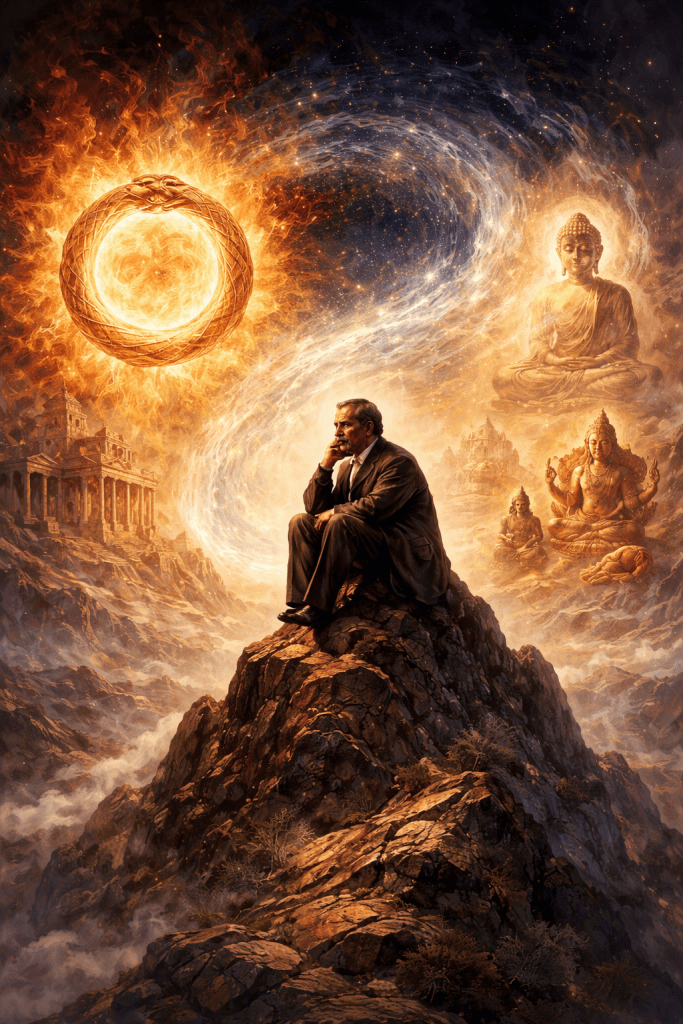
As will be shown in the next chapter, even two inauthentic variants of Eternal Recurrence, in relation to Nietzsche’s authentic one, arise from Hindu and Buddhist traditions, paradoxically preceding it. Thus the question arises whether we may call them “inauthentic variants” of Eternal Recurrence at all, if there is a possibility that Nietzsche himself was, at one point, inspired by them. It should nevertheless be noted that both the Hindu and Buddhist doctrines of eternal return are grounded on metaphysical foundations fundamentally different from Nietzsche’s. Above all, both concepts connect recurrence with the moral action of the individual, whereby return into the same or another life serves as a form of redemption. At the same time, Hinduism and Buddhism proceed from different ontological assumptions regarding the “subject” of return — Hinduism, which believes in the existence of the soul (ātman), claims that it is the self, whereas Buddhism, which does not accept such a soul, claims that these are merely “states of consciousness.”
Such hope for a new cycle of return — the hope that life may be altered and redeemed — paves the way for the religious belief in Eternal Recurrence that marked almost all ancient cultures. But we, “faithful to the earth,” can know nothing of this. Perhaps it does occur, says Nietzsche’s doctrine of Eternal Recurrence — but in a package together with the return of this very miserable and wretched life of ours, to which, if nothing else, we can at least point with a finger as real, since we are living it right now… After we have lived through countless lives in this same body, in various ways, for the sake of moral improvement (Hinduism), and after we have lived through countless lives in the body of a worm, a bat, or some other known or unknown animal — and perhaps even another human being (Buddhism) — the authentic variant of Eternal Recurrence “says” that we shall once again relive this miserable and wretched life of ours… The “surplus of life,” in this regard, presents no problem for it whatsoever.
[1] In Being and Time, Heidegger distinguishes two fundamental modes of human existence (Dasein): the authentic and the inauthentic mode of being. In the inauthentic mode, human beings live immersed in everydayness, guided by the indeterminate “they” (das Man), adopting established opinions and patterns without personally assuming responsibility for their own existence. By contrast, in the authentic mode of existence, Dasein takes over its own finitude and possibilities — especially through confrontation with death — and thereby becomes authentic in relation to its own being. Here, this distinction is applied, in an extended and metaphorical sense, to different modalities of Eternal Recurrence. The “authentic” is thus taken to designate the most consistent and existentially most radical form of recurrence — Nietzsche’s Eternal Recurrence of the Same — while the “inauthentic” refers to its softened religious variants.
 The Doctrine of Eternal Recurrence