(Doctrine of Eternal Recurrence — INTRODUCTION, aph. 9)
And although at first glance it seems that the doctrine or teaching of Eternal Recurrence draws its “blood” from other religions—above all from Hinduism and Buddhism—and that it borrows from them its basic outline, perhaps the opposite is true… Perhaps most, if not all, ancient religions rest upon that single archaic source: an insight into the Eternal Recurrence of the Same. This is one of the hypotheses explored in this book. What if the only certainty that can be reached at all in this world—“in itself” unknowable—has always been dimly intuited by a handful of exceptional minds of their time, who then, out of the greatest necessity, adapted it for the majority precisely through what we today call “religions”? In other words: what if religions themselves rest upon the principles of that ancient, forgotten tradition—and not the other way around?[1]
It is therefore hardly surprising that Nietzsche regarded the thought of Eternal Recurrence as one of his most important ideas—and that we interpret it here as a kind of “religion behind religions,” something that may even drive this entire eschatology. And we believe that this is precisely where it belongs. If it should turn out that in certain periods of human prehistory and history the belief in the Eternal Recurrence of the Same emerged as one of the significant eschatological features of their spiritual development, nothing prevents us from imagining a scenario in which this might continue to occur in the future as well.
But if we are to examine this possibility more seriously, what we need is an anthropologist of Eternal Recurrence—someone “of our kind,” prepared to undertake an anthropological and cultural investigation not yet undertaken: an inquiry into the beliefs of our “Ancients,” along the lines of what Mircea Eliade attempted in his book The Myth of the Eternal Return. Such an investigation would have to include not only the beliefs of the Sumerians, Babylonians, Egyptians, and Greeks, as well as those of the ancient peoples of the East and of the American continents, but also the beliefs from the dawn of the first great cultic centres and communities some eight or nine thousand years ago—in the “age of Göbekli Tepe.”[2] In other words, one would have to re-examine the beliefs of the earliest farmers gathered in primitive communities, and then perhaps go even further back into the past to investigate the beliefs of hominids of the later Stone Age (that is, the Upper Palaeolithic), who left their famous artistic testimonies on the walls of Altamira and Lascaux fifteen, twenty, and perhaps even forty thousand years ago.
And it will probably turn out that, besides philosophers and anthropologists, we shall also need mathematicians, physicists, and psychologists of Eternal Recurrence—and quite possibly even a computer programmer who might one day attempt to run a computer simulation of Eternal Recurrence as a contribution to the search for its proof. In that sense, this book is only a beginning. If we were to succeed in our intention—to find and win over such experts for the doctrine of Eternal Recurrence—and if they were in turn able to confirm the initial hypotheses with their findings, human beings might begin to live in this world as dedicated scientists or rational mystics—whichever they prefer—humbly examining and testing every one of its possibilities.
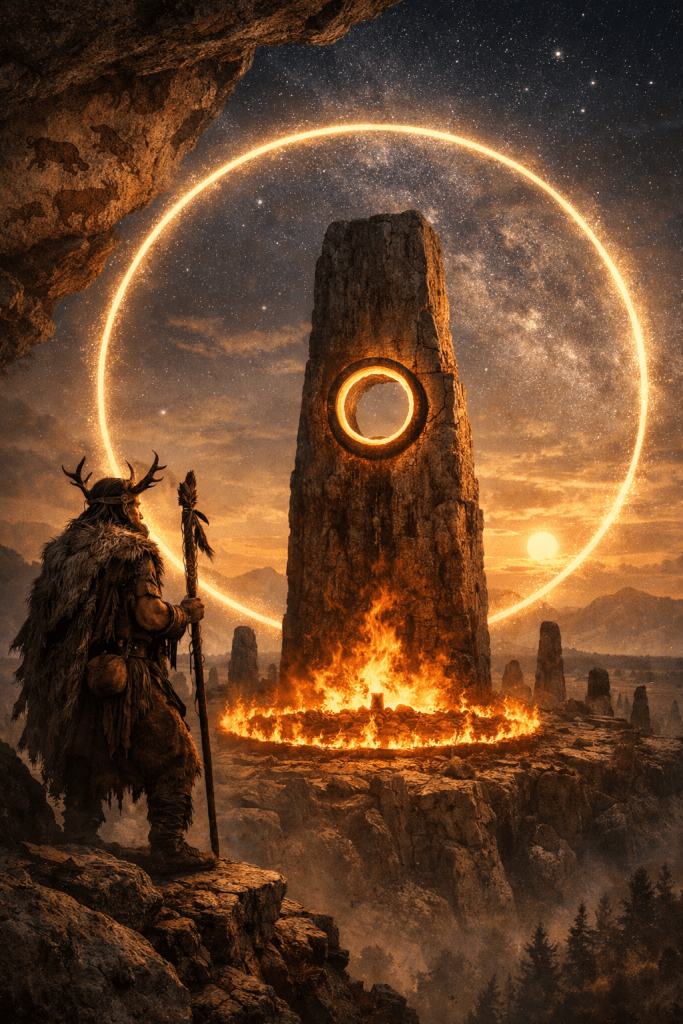
Yet we cannot help asking: how is it possible that the thought of Eternal Recurrence could even occur to anyone’s mind, especially at the earliest stage of the development of consciousness? How could such a sophisticated idea arise and be accepted in primitive societies rather than in highly civilized ones? This is even harder to grasp—and therefore harder to explain—than the previous question. We can imagine it only within the framework of an even bolder hypothesis: that already in the ancient nomadic tribes of early communities there existed individuals—shamans, seers, and guardians of sacred traditions—to whom, at some moment in their lives, the ring of Eternal Recurrence revealed itself in its monstrous force, to such a degree that, because of its unbearable nature, they had to keep it secret from the other members of their tribe. One might also imagine that nothing prevented them from introducing at least something of this supreme secret of existence—“sacred knowledge” of which only they were aware—into their rituals. The eternal circle. The eternal fire. In this way, even down to the present day, we can find traces of that possible highest teaching in many of the world’s religions. Nothing therefore prevents us from holding to our hypotheses and attempting to show how this teaching, within different religions of the world, gradually adapted itself to the tastes of the masses, depending on the cultural and geographical environments in which it arose, increasingly effacing itself and drifting away from its original form. If we succeed in this, we may perhaps also fulfil what could be called Nietzsche’s hidden intention: to make Eternal Recurrence not merely a “religion behind religions,” but a religion above other religions—a kind of “meta-religion”—something that it itself mysteriously hints at in part of its own name, in that “re” at the beginning, which in Latin means again (or once more).
[1] In ancient Egypt the scarab (dung beetle) was taken as a symbol of renewal and the repetition of life, associated with the idea of cosmic rebirth. In some of the great cultures of Central America—especially among the Maya and the Aztecs—time was conceived as a succession of cosmic cycles or epochs. In ancient Greece, the idea of eternal recurrence was sometimes connected with certain Presocratic thinkers, such as Heraclitus and Empedocles, and received its most developed form in Stoic philosophy, particularly in the doctrine of the periodic destruction and rebirth of the world. In Virgil’s Aeneid (Book VI), an intriguing motif appears: before a new life, souls drink water from the river Lethe in order to forget their previous experiences. Only after this forgetting do they re-enter the world of the living, where they are destined to relive suffering, errors, but also brief moments of pleasure. In Indian religions—Jainism, Hinduism, and Buddhism—the idea of an unending cycle of birth and rebirth (samsara) likewise appears, from which human beings seek to free themselves through salvation or enlightenment. Even the Christian idea of the Resurrection may—at least from one philosophical perspective—be interpreted as a faint echo of a much older and more archaic insight into the repetition of life. We might briefly imagine the Resurrection in a different light: it is true that we “rise from the dead,” that we have indeed “been resurrected,” but not in order to spend eternity in Heaven with God, but rather in order to live once again this one and the same life in this one and the same skin.
[2] Göbekli Tepe is a prehistoric archaeological site in southeastern Anatolia (present-day Turkey), dated approximately between 9600 and 8000 BCE. It is considered the oldest known monumental cult complex in the world and provides evidence of highly developed religious practices long before the emergence of permanent agricultural communities.
 The Doctrine of Eternal Recurrence