(Doctrine of Eternal Recurrence — INTRODUCTION, aph. 6)
Yet before it can be grasped in its epistemological depth and attain the status of a “justified true belief,” the doctrine of the Eternal Return of the Same must first be believed. And although it enters the domain of religions, the doctrine of the Eternal Return seems to remain beyond the reach of their teachings, above all because of its indifference toward questions of God, that is, toward the beginning and the end of the world. Even if we initially approach this indifference to the “question of all questions” of every eschatology as a certain weakness of the doctrine—since it offers no argument to show why the world could not have a beginning and an end, advocating only its cyclicality—this very indifference, on the other hand, places the doctrine of the Eternal Return in a conciliatory position toward the teachings of other religions.
As a kind of “meta-religion” or “trans-religion,” the doctrine of the Eternal Return is willing to listen to the narratives of other religions about how this world came into being, how it itself came into being—the ring of the Eternal Return—and at times to grant them authority, and at other times to withdraw it. Yet it must not be forgotten that it does so for one reason alone: because these stories of the origin and the end of the world do not belong to the domain of its thought. Nor can it be entirely certain whether the ring of the Eternal Return truly came into being at some distant time in the past. Perhaps it did—although its own religion, its own faith, tells it that it has “existed” forever. Of this, it can possess no knowledge. It merely shows how this world, seen from within, functions. It says nothing about when it began or when it will end, nor about who created it or who will destroy it. In this play of tolerance with other religions, the doctrine of the Eternal Return may acknowledge their beginnings and ends of the world, while for itself it binds the notions of beginning and end exclusively to the beginning and the end of a single cycle, that is, of a single ring of the Eternal Return—both of which, at present, remain unknown even to itself.
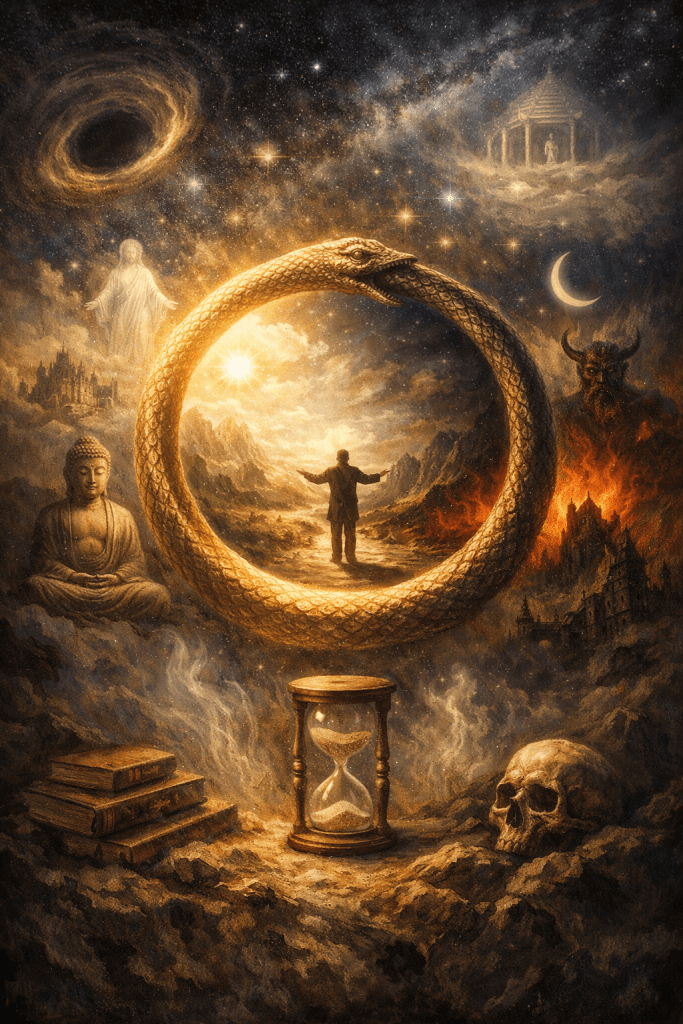
In this sense, the doctrine of the Eternal Return does not ask you to abandon your religion, with quotation marks or without them. You may remain Christians or Muslims, Hindus, Buddhists, or Taoists, as well as adherents of other faith communities and spiritual traditions; you may continue to claim that you are atheists or scientistic thinkers; or you may remain uncommitted as skeptics or agnostics. It speaks only of this: that everything you experience in the sensory world, or suppose you may experience in the supersensory, is subject to a single fatum—returning. Here one must pause, for what follows marks a shift in the understanding of the doctrine of the Eternal Return: as Nietzsche conceived it—though he never stated this explicitly—it also encompasses the return of all possibilities of the supersensory world, insofar as these are real, that is, truly “at work.” If our world amounts to a single finite Whole, it is incapable of endlessly producing new possibilities. After eons upon eons spent not only on Earth, but also in heaven or in hell, in communion with God or with the Devil, in higher dimensions, in nirvana or in singularity, reincarnating into different modes of existence and repeated embodiments—the numinous, majestic Whole is compelled to return you, because it has simply exhausted all other possibilities…..
 The Doctrine of Eternal Recurrence