(Doctrine of Eternal Recurrence — Preface, aph. 11)
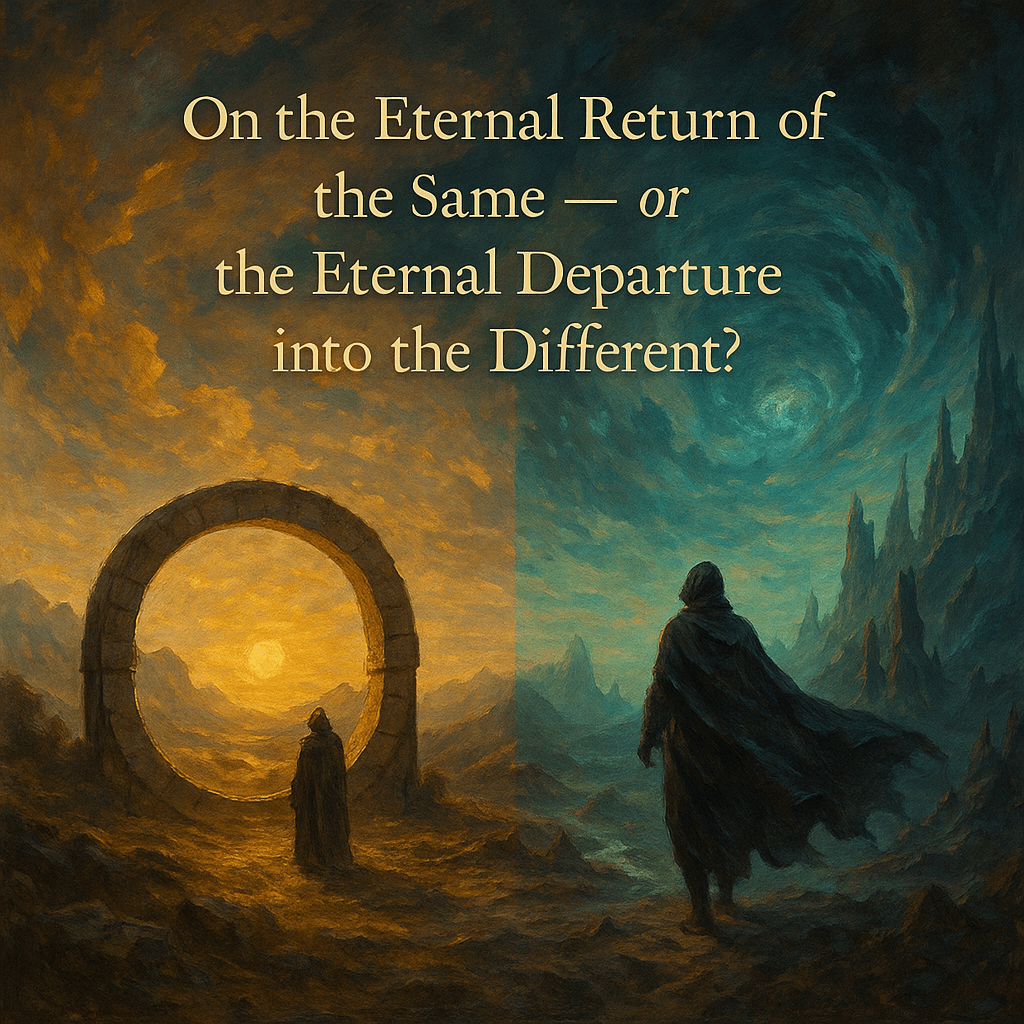
And so — is it the Eternal Return of the Same that is “at work,” or the Eternal Departure into the Different?
And since we have already mentioned this second possibility — the one that, at this moment, appears “victorious” and widely accepted in the clash of eschatological, or rather eschatological-cosmological possibilities concerning the question of how this world works — it is difficult not to point out the way in which it feels victorious. It is approached almost as a fact of the world itself. Who, today, would dare deny that space is infinite and that time is infinite? It is precisely for this reason that this possibility no longer feels like a possibility — like one eschatological possibility among other eschatological possibilities. No one thinks of it in its original eschatological form: as the “Eternal Departure into the Different,” stepping onto the field against another “possibility above all possibilities” — the Eternal Return of the Same. This raises the question of whether we can add to these two possibilities any other of equal weight — perhaps only that of metempsychosis and reincarnation, which pertain primarily to the Eternal Return of the Self in the Hindu and Buddhist traditions, rather than to the return of the world as a totality; and, of course, that unavoidable possibility of Eternal Heat Death, or the End — which stands in a kind of symmetrical relation to the Big Bang, that is, to a single Beginning… and that is all. All these eschatological, as well as eschatological-cosmological possibilities, will be examined in detail in this book. What we wish to emphasize here is that when the question is posed from the eschatological vantage point of possible scenarios of how this world functions — whether everything is inclined to return (or to repeat, roughly speaking) or is instead endlessly new — it quickly becomes clear that there is still no final answer to it, and that new questions sprout from it continually.
If we assume, in the Kantian spirit, that these questions are “practical” enough to evade an antinomic fate, would it not then be permissible to seek an answer to them…?
What if our insatiable hunger for meaning, our attachment to morality, our tedious pragmatism, our will to survive and will to power — in a word, our humanity, in both its affirmative and pejorative senses — compels us, within this increasingly unbearable nihilistic atmosphere, to seek an answer nonetheless? And if so — what kind of answer would it have to be, in its structure and in relation to the one to whom it is addressed? Would it not have to encompass our reason, our intellect, our heart, and our feelings…? If we could demonstrate its practicality, as well as its usefulness for the preservation of the species, then it would indeed be permissible to seek such an answer. Just as, according to Kant, it is impossible to stand beyond morality (“the moral law within me”) that governs our practical actions — even though one may stand beyond a particular morality, such as the morality of good and evil, as Nietzsche did — so too there may be certain questions to which we must have an answer, despite our skepticism regarding its ultimate credibility, which will continue to linger quietly in its shadow.
And therefore — let us boldly and cheerfully repeat the question: Is it the Eternal Return of the Same that is “at work,” or the Eternal Departure into the Different? And even if it seems difficult to find a coherent answer, and even if new questions arise unceasingly from this one..… perhaps the answer ultimately depends on which of the two we choose to entrust not only our reason and our intellect, our heart and our feelings, but — may we already say this here, in the Preface? — our “new faith” as well…
[End of the Preface]
 The Doctrine of Eternal Recurrence